

Fragile food supply systems, bioregionalism, and planting the Three Sisters: Pt 1
How we’re responding to the fuel and fertilizer shortages by cultivating a relationship with the Earth around us
A majority of Americans lament the imperialistic wars waged by the military industrial complex for the hidden (or overt) agenda to acquire fossil fuels. Simultaneously, those same people fail to see their immense reliance on fossil fuels for acquiring basic needs like food and clothing. The USDA estimates that as of the last measurement in 2007, the food system consumes 15.7% of the national energy budget (Fuel for Food: Energy Use in the U.S. Food System | Economic Research Service).
These include fertilizer inputs on industrial farms, heavy farm equipment, bulk packaging and retail packaging, and transportation between each step of the process. Furthermore, the food we consume is extraordinarily pollutive. The total Greenhouse Gas Emissions (GHG) of food production in 2016 was 970 Million Metric Tons (MMT) in 2016, with 70% of those emissions from raising animals for food (Armstrong et al.). On top of this, 27% of all the food produced is wasted (“Food Wasted in the U.S. Leads to Massive Amounts of Wasted Energy”), that’s roughly equivalent to $165 billion USD in wasted food (“NRDC: Wasted – How America Is Losing Up to 40 Percent of Its Food from Farm to Fork to Landfill (PDF)”).
We could dramatically reduce waste and emissions through an approach known as bioregionalism: An ecological and cultural philosophy emphasizing living in harmony with local natural systems—such as watersheds, ecosystems, and landforms—rather than arbitrary political boundaries (“Bioregionalism”). It provides a sensible approach to organizing economics, agriculture, and governance around the local ecology and time-honored Indigenous wisdom rather than modern political systems and boundaries. To understand why bioregionalism can offer a more resilient and adaptive system, let’s consider how we currently meet our basic needs.
The Current State of Subsistence: Unnecessarily Complicated
In many countries and especially the United States, meeting our basic needs is deeply tethered to fossil fuels. Let’s examine closely the convoluted steps we take to simply acquire vegetables for a meal.
- Determine the food you want to eat – usually in the form of a recipe
- Think about which grocer will carry the food you want
- If you’re one of those people who goes to multiple stores for specific items or discounts, add a layer here for gas consumption and emissions.
- Consider the cost of the groceries
- Consider how you will earn enough money to afford the groceries
- Determine the task that appeals to the values of enough people with money to pay for it
- Market the chosen task
- Perform the task for clients
- Receive some form of currency in exchange
- Take your currency to the grocer
- Pick out all your produce, much of which goes through the following steps, in reverse order, before reaching you:
- Grocer interfaces with a warehouser/logistics department that buys large quantities of produce, pre-wrapped in petrochemicals.
- Packaging/Shipping company interfaces with farmers and petroleum companies to acquire the produce and the means to plastic wrap it
- Farmers from thousands of miles across the planet plant and grow the food
- Wrap already shrink-wrapped produce in loose fitting petrochemical bags at the counter (because you forgot your canvas totes at home… again!) to carry it to your vehicle
- Burn petroleum to drive yourself home to finally cook your produce
Does this seem bat-manure crazy? It’s truly unbelievable how complicated the logistical chains have become just to procure produce. The net effect is fragility; each link in this chain implies a reliance on fossil fuels, which are a non-renewable resource and primary driver of climate change and price instability. These perturbations to convenience are going to continue to happen, likely with greater frequency and magnitude of disruption as we continue to push against planetary limits. How do we respond as individuals to risks at this scale?
Our Call to Action
Instead of perpetually seeking more petroleum through military aggression (e.g. wars), subterfuge (e.g. regime change to install politicians favorable to US foreign policy), and coercive extraction (e.g. offshore drilling and labor extortion, often in countries with little or non-existent labor protection laws), we can choose a path of radical resilience by returning to the foundational act of growing our own sustenance. In doing so we can create circular, simplified and direct food production and delivery systems.
The excessively complicated supply chains involved in delivering non-local goods in aggregate creates a brittle system that is easily broken when natural disasters and geopolitical tensions like wars, tariffs, or labor uprisings impinge on the links in the chains.
We see an example of this at present with the rapid increase in fertilizer prices during peak Spring demand due to the closure of the Strait of Hormuz in response to US military aggression against Iran, which will ultimately drive subsequent price hikes in food costs.
Here at Buy From Friends we’re re-envisioning a sustainable future (literally) from the ground up. We’re orienting back towards the foundations of life and starting at the very base of Maslow’s Hierarchy of needs, endeavoring to meet our ‘Physiological Need’ for food through direct relationship with the land and the local community.
If you’re eager to play a role in a peaceful path to a sustainable future you can start by finding growers in your local area, through a farmer’s market or CSA, and begin Buying from Friends! Doing so will make you new friends, and will dramatically reduce the footprint of your food! Or you can come along this journey with us as we step into direct relationship with our produce by planting it ourselves. It’s not easy. It requires patience and observation over immediate action, learning the conditions conducive to the thriving of each of the plants you consume, curating those conditions, and then planting the seeds yourself!

Our First Steps to Food Sovereignty: Three Sisters
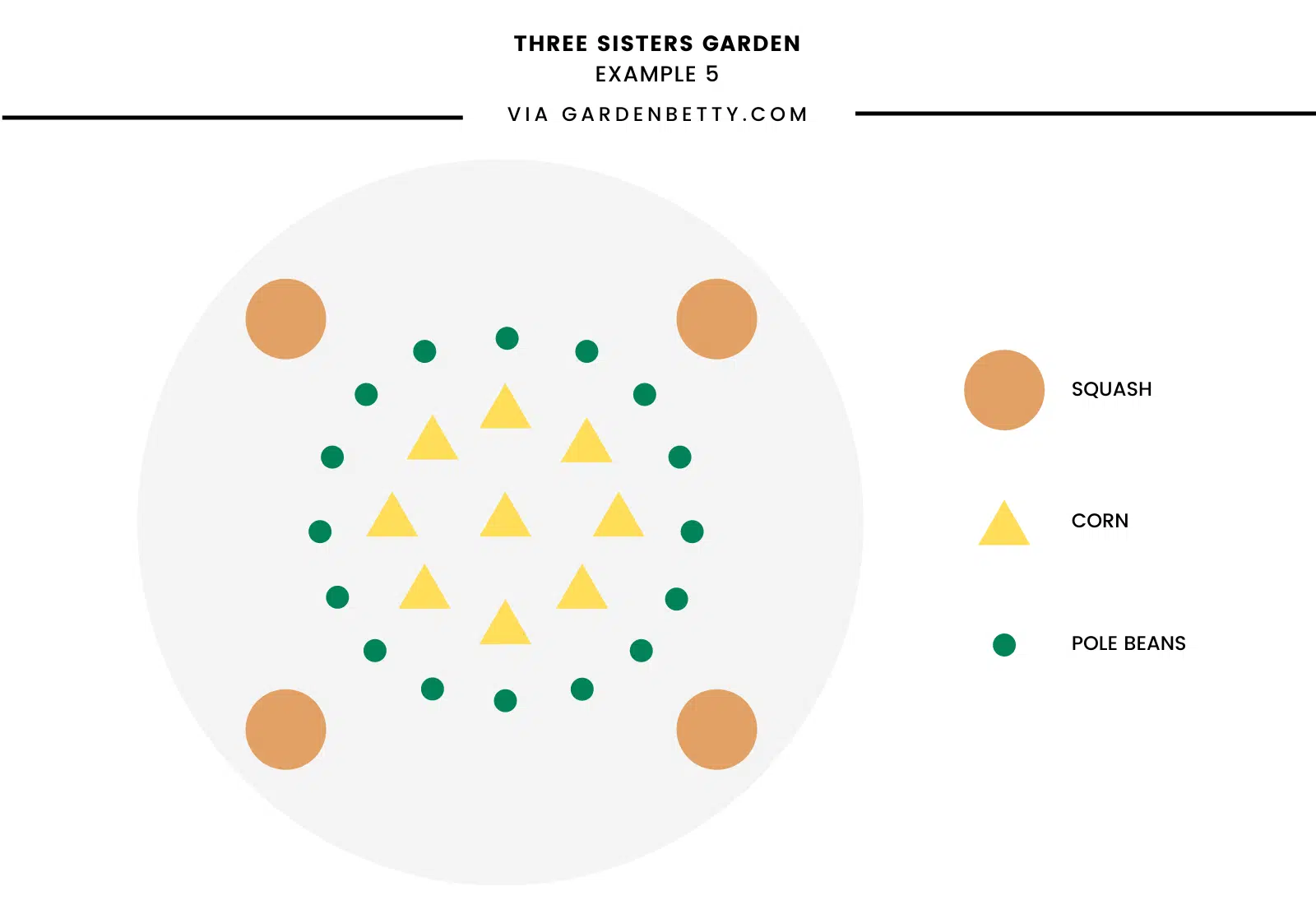
I (Stephen) am an avid follower of The Great Simplification podcast by Nate Hagens and when I heard the “Wide Boundary News: Biodiversity Depletion, Iran & the Strait of Hormuz, and the Green Wedge” episode on February 23rd I was stirred. The episode detailed the downstream consequences of the closure of the Strait of Hormuz and the cascading impacts it will have on fertilizer inputs and thereby food prices. I quickly came to the conclusion that it was time to take a step that’s been in R&D since Fall 2024 and make a large plot for planting an ingenious indigenous people’s companion-planting pattern: The Three Sisters. Comprised of corn for the sturdy stalks, scarlet runner beans (or a nitrogen fixing, vining legume of any kind) that rely on the stalks to run upwards for sun exposure and reciprocate with nitrogen in the roots, and squash (we’ll be planting multiple types: luffa, summer, acorn, and butternut) to shield the soil from the intense heat of the sun that we see here in the Georgia summer.
I first heard about the Three Sisters while reading Robin Wall Kimmerer’s Braiding Sweetgrass a few years ago and the intention to cultivate them stuck. The indigenous peoples knew intuitively that these plants formed symbiotic relationships, and science has confirmed that intercropping, of which the Three Sisters is an example, has a dramatic impact on output. A meta-analysis of 126 studies comprising 939 intercropping observations shows that intercropping, when compared to the same area of land that was managed in monoculture, produced 38% more
gross energy and 33% more gross incomes on average, whilst using 23% less land (Martin-Guay et al.).
With a little time exploring Youtube for detailed accounts of how to plant the Three Sisters, I found this video: Planting Corn, Squash and Beans Using The Three Sisters Method and read the article Planting a Three Sisters Garden where I found the pattern that felt like a good fit for our plot.
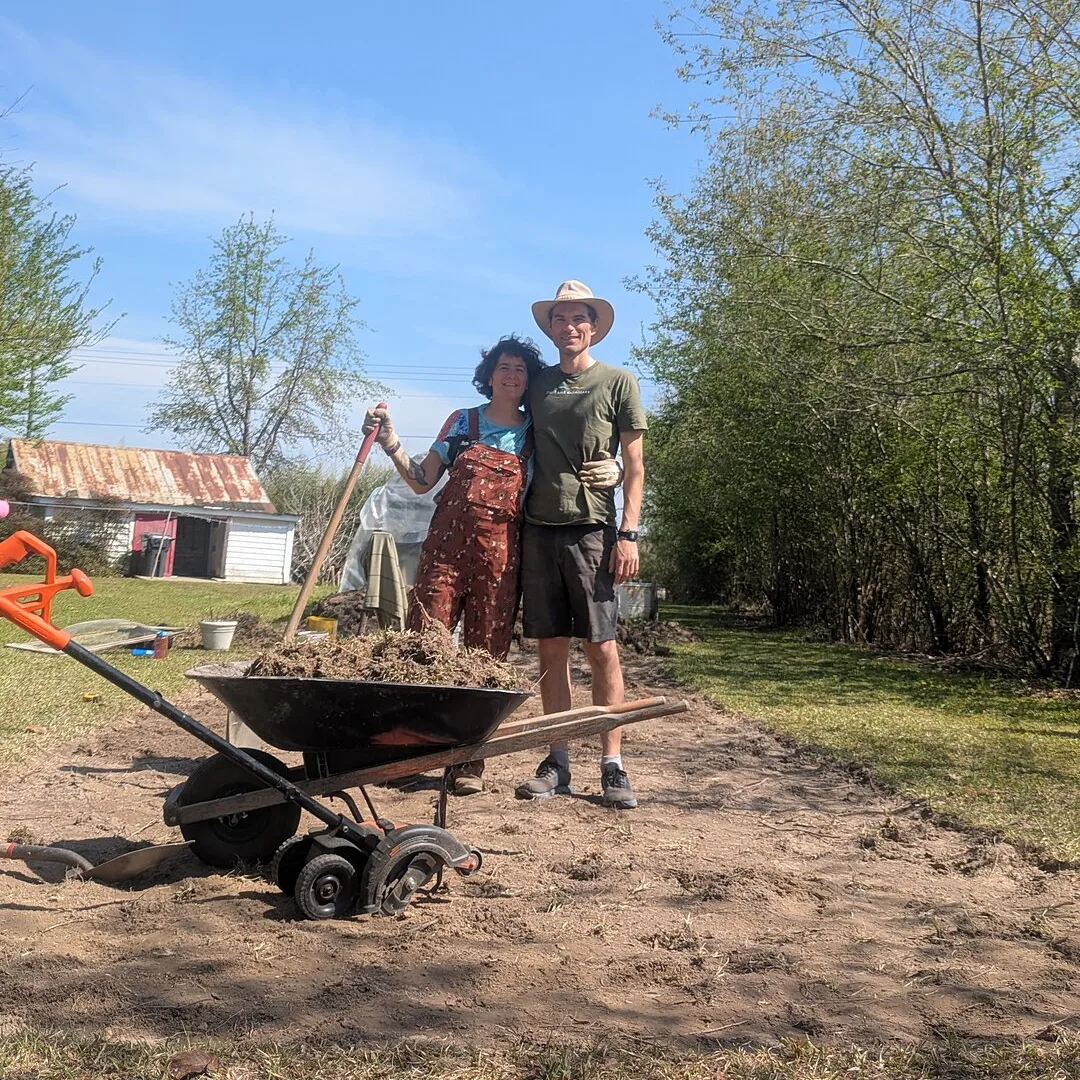
Starting with measuring tape, a square shovel, a wheelbarrow and a wing and a prayer, I set to work measuring a lawnmower width passage between our existing greenhouse and the intended plot. Then, I traced the long edge the full length of the south-eastern side of the property that gets the most sun, up to the furthermost water spigot coming off of the highway (We installed it a couple years ago for the purposes of irrigation). The long side was 34’ in total with a width of 11’ and that’s when it came time to put my lanky body to work, prying up square clumps of grass, shovelfull by shovelfull, and piling them near the greenhouse.
Across three days and about 8 hours of shoveling and wheelbarrowing with help from Nicole, the surface layer of the soil had been cleared!
Next week we’ll explore how we plan to provide water for our new Three Sisters plot!
Did you find this article informative? Consider leaving a tip below.
Bibliography
- Armstrong, Kristina, et al. “Estimating Energy Consumption and GHG Emissions in the U.S. Food Supply Chain for Net-Zero.” Npj Science of Food, vol. 9, no. 1, Feb. 2025, p. 19. www.nature.com, Link
- “Bioregionalism.” Cascadia Department of Bioregion, Link. Accessed 18 Apr. 2026.
- “Food Wasted in the U.S. Leads to Massive Amounts of Wasted Energy.” Yale E360, Link. Accessed 19 Apr. 2026.
- Fuel for Food: Energy Use in the U.S. Food System | Economic Research Service. Link. Accessed 19 Apr. 2026.
- Martin-Guay, Marc-Olivier, et al. “The New Green Revolution: Sustainable Intensification of Agriculture by Intercropping.” Science of The Total Environment, vol. 615, Feb. 2018, pp. 767–72. DOI.org (Crossref), Link
- “NRDC: Wasted – How America Is Losing Up to 40 Percent of Its Food from Farm to Fork to Landfill (PDF).” Link. Accessed 19 Apr. 2026.
